In most restaurants, the kitchen is where profits are protected — or quietly lost.
Poor kitchen section management leads to slow service, confused staff, repeated remakes, and unhappy customers. Even when food quality is excellent, weak coordination between kitchen sections can cripple the entire operation.
For Nigerian restaurants dealing with peak-hour rushes, limited staff, and high customer expectations, effective kitchen section management is no longer optional. As restaurants grow, managing the kitchen as one single unit stops working.
Orders don’t just go to “the kitchen” — they go to different sections, each with its own pace, staff, and responsibilities. Without proper kitchen section management, restaurants struggle with delays, missed orders, and constant back-and-forth between staff.
This is why modern restaurants now manage kitchen sections independently, not as one crowded queue.
What Is Kitchen Section Management?
Kitchen section management is the ability to split kitchen operations into clearly defined sections, such as:
- Main Kitchen
- Bar
- VIP section
- Children’s menu section
Each section receives, processes, and completes only the orders meant for it, instead of every staff member seeing everything at once.
This approach reduces noise, improves speed, and creates accountability.
Why Kitchen Section Management Matters in Nigerian Restaurants
Many Nigerian restaurants face unique operational pressures:
- high-volume dine-in traffic
- peak periods concentrated in short windows
- limited kitchen space
- multitasking staff
- manual order handling
In many restaurants:
- bar orders slow down food orders
- VIP orders get mixed with regular tables
- children’s meals are delayed behind complex dishes
- staff constantly ask, “Is this for us or the bar?”
When all orders land in one place, confusion is guaranteed.
With kitchen section management:
- each section focuses only on relevant orders
- workloads are balanced
- service becomes predictable, even during rush hours
How Kitchen Section Management Works on Lumi Business
With Lumi Business, kitchen section management is handled through clearly defined operational sections.
From the section dashboard:
- staff select the specific section they manage
- only orders assigned to that section are displayed
- each section works independently without interference
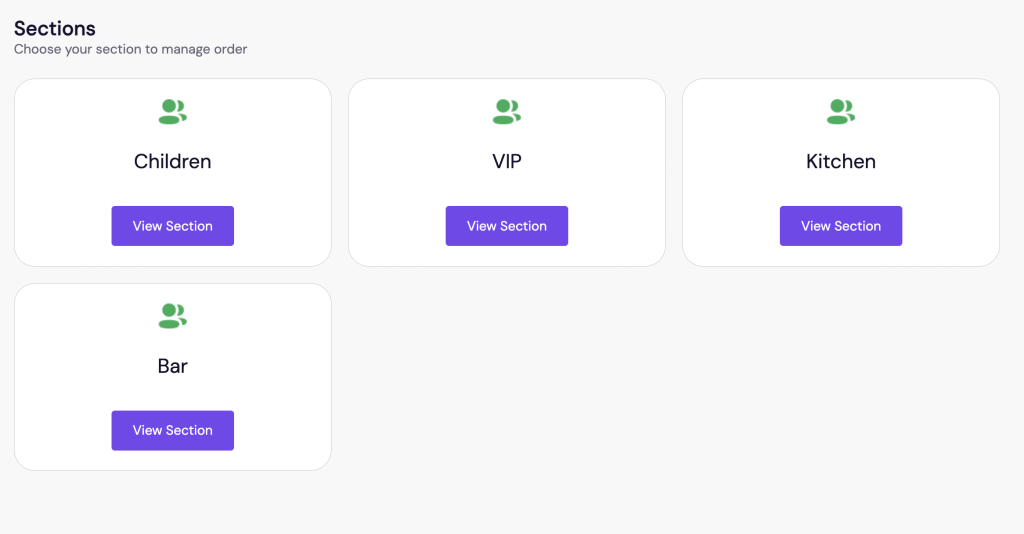
For example:
- the Bar only sees drink orders
- the Kitchen handles main meals
- VIP orders can be prioritised separately
- Children’s meals are handled without delay
This prevents one section from slowing down the entire restaurant.
Benefits of Managing Kitchen Operations by Section
1. Faster Order Processing
When sections only see what they need, decisions are quicker and execution is faster.
2. Clear Responsibility
Each section knows exactly which orders belong to them.
3. Better Staff Coordination
Front-of-house staff know where orders are being handled, reducing unnecessary trips to the kitchen.
4. Improved Customer Experience
VIP guests receive priority service, children’s meals arrive on time, and drinks are served without holding up food.
5. Scalability Without Chaos
As order volume increases, sections absorb the load instead of collapsing under it.
Section-Based Kitchen Management VS Traditional Kitchen
| Traditional Kitchen | Section-Based Kitchen Management |
|---|---|
| One crowded order queue | Separate, focused sections |
| Constant interruptions | Clear workflows |
| Staff confusion | Defined ownership |
| Slower service | Faster turnaround |
| High stress | Controlled operations |
Why Section-Based Management Is the Future of Restaurant Kitchens
Restaurants are no longer simple operations.
They serve:
- dine-in guests
- bar customers
- VIP tables
- families with children
- delivery and pickup orders
Managing all of this through a single kitchen queue is no longer sustainable.
Kitchen section management allows restaurants to run multiple workflows at once, without losing control.
Conclusion
Kitchen section management isn’t about adding complexity — it’s about creating order.
By assigning orders to the right section, at the right time, restaurants:
- move faster
- make fewer mistakes
- reduce staff stress
- deliver a better customer experience
Platforms like Lumi Business make this possible by turning kitchen sections into structured, manageable workflows that allow orders to be tracked on each section’s Kitchen Display System.
Frequently Asked Questions About Kitchen Section Management
What is kitchen section management in a restaurant?
Kitchen section management is the practice of organising a restaurant kitchen into clearly defined sections—such as main kitchen, bar, VIP, or children’s section—so that each section handles only the orders assigned to it. This improves speed, accountability, and coordination during service.
Why do restaurants need kitchen section management?
Restaurants need kitchen section management to avoid order congestion and confusion. When all orders flow into one queue, delays and mistakes increase. Section-based management ensures the right staff handle the right orders at the right time, especially during peak hours.
What types of kitchen sections can a restaurant have?
Common kitchen sections include:
- Main kitchen (mains and complex dishes)
- Bar (drinks and cocktails)
- VIP section (priority or special service)
- Children’s section (simpler, faster meals)
Sections can be customised based on menu structure and service style.
How does kitchen section management improve service speed?
By limiting each section to only relevant orders, staff make faster decisions and execute tasks without distraction. This reduces bottlenecks, prevents unnecessary back-and-forth, and helps meals reach customers on time.
Is kitchen section management only for large restaurants?
No. Small and mid-sized restaurants also benefit from kitchen section management, especially if they:
- serve both food and drinks
- handle VIP or special orders
- experience rush hours
- want clearer staff accountability
Even two sections (e.g., kitchen and bar) can significantly improve operations.
What happens if a restaurant does not manage kitchen sections properly?
Without proper kitchen section management, restaurants often experience:
- mixed-up orders
- delayed meals
- staff confusion
- repeated remakes
- stressed kitchen teams
These issues affect customer satisfaction and profitability over time.
Can kitchen section management work without technology?
It can work at a very small scale, but manual systems break down as order volume increases. Verbal instructions and paper tickets make it difficult to track which section is responsible for each order, especially during busy periods.
How does technology support kitchen section management?
Technology supports kitchen section management by:
- routing orders to the correct section automatically
- showing section-specific order queues
- updating order status in real time
- reducing reliance on verbal communication
This creates structure and visibility across the kitchen.
How does Lumi Business handle kitchen section management?
Lumi Business allows restaurants to define multiple kitchen sections and assign orders accordingly. Each section views and manages only its own orders, helping teams stay focused, organised, and efficient during service.
Can kitchen sections be adjusted as a restaurant grows?
Yes. Kitchen sections can be added, merged, or restructured as menu offerings expand or service patterns change. This flexibility allows restaurants to scale operations without losing control.
Is kitchen section management worth the effort?
For restaurants that want faster service, fewer mistakes, and calmer kitchen operations, kitchen section management is absolutely worth it. It replaces guesswork with clear structure and helps teams perform consistently under pressure.