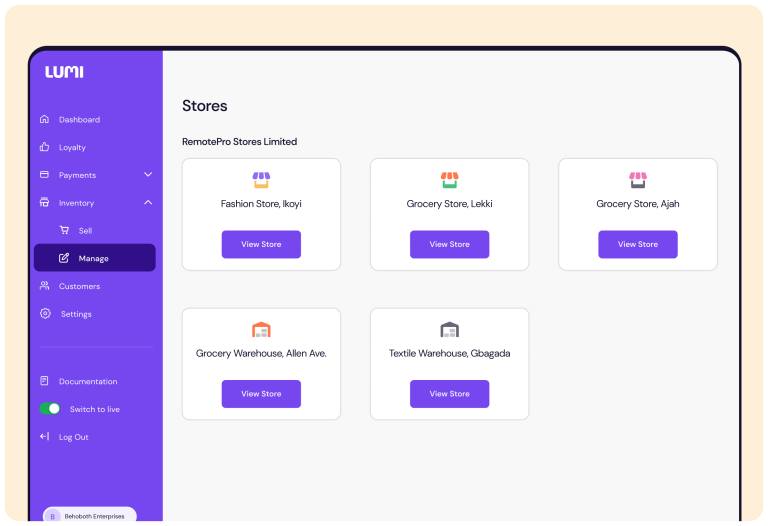
The best way to manage stock across multiple stores in Nigeria is to use a centralized inventory system, standardize branch operations, and track stock movement in real time across all locations. This ensures visibility, reduces losses, prevents stockouts, and helps businesses scale without losing operational control.
Growth for most Nigerian businesses eventually leads to one big milestone: opening more branches. When a business owner asks, “What’s the next level for my business?” — they’re usually referring to expanding into a new location. Learning how to manage stock across multiple stores in Nigeria is essential for any business that plans to expand successfully. To scale effectively, businesses must maintain visibility, control, and accuracy across every store.
Think about a brand like Medplus. You know the name not only because of strong marketing, but because you see their stores everywhere — malls, major streets, across Lagos, Abuja, Port Harcourt, and more. That visibility is a direct result of multi-branch expansion done right.
For many Nigerian entrepreneurs, the next level is clear:
- Open a new branch
- Grow the brand
- Expand into new locations
- Multiply your reach
And yes — expansion comes with real benefits.
Benefits of Business Expansion
Expanding into multiple locations offers several benefits, but each advantage comes with operational responsibilities that require strong inventory control. Some benefits include:
- Improved Brand Visibility: More people see your business in more places.
- Access to New Customer Segments: Each location opens the door to a new market.
- Higher Revenue Potential: More branches = more sales opportunities.
- Competitive Advantage: Multi-city presence strengthens your brand authority.
- Operational Leverage: You can negotiate better prices, buy in bulk, and scale faster.
Multi-city presence strengthens your brand authority; you can negotiate better prices, buy in bulk, and scale faster. Expansion is not just opening more locations — it’s managing more complexity.
Many entrepreneurs focus on the excitement of opening a new store, but expansion brings serious operational challenges. Not preparing for these challenges early is one of the biggest reasons multi-branch businesses struggle or shut down entirely.
Before opening a second or third branch, you must forecast operational risks, understand the hidden challenges and put proper systems in place. Because the first step in successful expansion is knowing what could go wrong — and planning ahead.
Key Challenges of Managing Multiple Branches in Nigeria
Managing multiple stores in Nigeria introduces new inventory challenges that cannot be handled with manual systems. Here are the challenges Nigerian businesses commonly face when they expand:
- Inventory Visibility Across Multiple Stores: One major difficulty Nigerian SMEs face is learning how to manage stock across multiple stores in Nigeria while maintaining accuracy. Without a centralized system, you cannot see:
- What’s in stock in Store A vs. Store B
- Which location has excess or insufficient stock
- Where items are missing, damaged, or unaccounted for
- Stock Transfers & Accountability: Inter-branch stock movement is hard to track manually. This is where many businesses lose money through:
- Undocumented transfers
- Misplaced products
- Staff errors
- Shrinkage or theft
- Stock Expiry & Damage Management: Businesses dealing in FMCG, beauty products, food, or pharmaceuticals struggle with:
- Monitoring expiry dates
- Tracking damaged items
- Preventing waste across locations
- Demand Forecasting for Each Location: Different branches have different sales behaviours.
- Store A may sell 50 units a week…
- Store B may sell 10. But many businesses use one centralized reorder pattern and they do not understand that it is a recipe for overstocking, stockouts, and lost revenue.
- Staff Performance & Process Consistency: Each branch has a different team with different habits and different levels of accountability. Without standardized processes, operations quickly fall apart.
- Financial Consolidation & Reporting: When branches are not connected to one system, owners struggle to see daily sales by branch, Track profit & loss per location, Reconcile stock vs. sales, Audit expenses and Manage cash and digital payments. Financial blind spots become bigger as branches grow.
- Technology & Operational Control: Growth without the right software becomes overwhelming. This is why many businesses open new branches but collapse operationally, because back-end systems cannot support expansion.
Once you open a second or third location, manual or limited inventory processes will no longer sustain you. You need systems that provide visibility, control, accuracy, and standardization — especially when it comes to inventory, which is the heart of any retail or wholesale business.
In a recent LinkedIn post, So Fresh CEO Olagoke Balogun shared how expansion exposed deeper inventory challenges as they grew from a small operation to a multi-location brand across major cities. The more the business expanded, the more complex inventory became — a reality many business owners eventually face. This leads to losses, errors, stockouts, and financial leak.
How to Manage Stock Across Multiple Stores in Nigeria
The most reliable way to manage stock across multiple stores in Nigeria is to combine standardized processes with centralized inventory software.

Here are the systems, tools, and practices every expanding business should implement:
- Create Standard Operating Procedures (SOPs): Your operations manual should clearly outline how your team handles customer service, manages sales processes, controls inventory, carries out stock transfers, manages cash and payment procedures, and prepares accurate reports. This ensures every branch follows the same standards and operates consistently.
- Implement a Centralized Inventory & POS Management System: Software solutions make it easier to manage stock across multiple stores in Nigeria by providing real-time reporting. Research shows that many Nigerian SMEs still struggle with stockouts, excess stock and poor record-keeping all due to lack of proper inventory tools. Modern POS and inventory systems — such as Lumi Business, Bumpa, Vend, Retail Cloud, Loyverse, and Cloud POS — offer essential features such as real-time stock visibility across branches, automated reorder alerts to prevent stockouts, barcode tracking for accurate inventory movement, and branch-level profitability reports that help business owners understand how each location is performing. A tool like Lumi Business goes even further by allowing businesses to:
- Create and submit purchase orders directly to suppliers
- Track incoming goods
- Monitor stock movement across branches
- Reconcile stock on shelf
- Perform Regular Inventory & Financial Audits: Using a software like Lumi Business, business owners can detect loses early by conducting:
- Stock counts
- Value comparison reports
- Cash vs. sales reconciliation
- Expense audits
- Set Up a Strong Financial Structure & Control Cash: Nigeria is rapidly shifting toward cashless business operations. According to NIBSS, electronic payment transactions reached ₦387 trillion, proving widespread adoption of digital payments. Lumi Business integrates with financial partners to help owners manage: Inventory, Payments, Expenses, Accounting all in one place.
- Build a Strong Supply Chain: A central warehouse system is one of the best ways to manage stock across multiple stores in Nigeria efficiently. To strengthen your supply chain, you can use a centralized warehouse, establish automated restocking rules, and track stock movement from the warehouse to each store and across branches. Lumi Business supports this process with tools for managing stock transfers, overseeing warehouse-to-store distribution, and communicating directly with suppliers.
- Hire, Train & Incentivize Staff: Expansion requires more people—but more importantly, trained and accountable people. You need competent store managers, inventory officers, cashiers who understand the system, and sales staff with clear KPIs. Proper training ensures consistency across all branches and significantly reduces operational failures.
- Adapt to Local Market Differences: Each city has unique customer behavior, price sensitivity, and product demand, which means your pricing, product mix, and restocking cycles must be adapted to fit each local market.
- Track Performance Across All Branches: To scale successfully, you need real-time visibility into sales trends, inventory turnover, expenses, profitability, and staff performance. With Lumi Business, businesses can trackTo scale successfully, you need real-time visibility into:
- Inventory losses
- Business profitability per branch
- sales performance by store
- stock history
- cost of goods sold (COGS)
- Expense tracking per store
- Staff performance metrics
- Top customers & buying patterns
Managing stock across multiple stores in Nigeria requires structure, visibility, technology, and consistent processes. Expansion is not just about opening new branches — it’s about building systems that allow your business to operate seamlessly across locations.
Any business planning expansion must know how to manage stock across multiple stores in Nigeria to avoid losses and operational breakdown. Whether you run a supermarket, fashion store, pharmacy, restaurant chain, beauty store, or FMCG distribution business, tools like Lumi Business make multi-branch inventory management simple, accurate, and scalable.
Frequently Asked Questions (FAQs)
1. How do I manage stock across multiple stores in Nigeria?
You can manage stock across branches by using a centralized inventory system, setting SOPs, performing regular audits, and using POS tools like Lumi Business, Bumpa, Vend, Retail Cloud, Loyverse, and Cloud POS that provide real-time stock visibility, branch reporting, and automated restocking.
2. What is the best software for multi-store inventory management in Nigeria?
Lumi Business, Vend, Retail Cloud, Loyverse, and Bumpa are popular options. For multi-branch operations, Lumi Business stands out because it includes purchase orders, stock transfers, warehouse management, branch-level reporting, and integrated financial tracking.
3. How can I prevent stockouts and overstocking across branches?
Use automated reorder alerts, centralized stock monitoring, accurate demand forecasting for each location, and a system that tracks stock movement from warehouse to branches.
4. How do I track inventory losses across multiple stores?
Tools like Lumi Business allow you to record expired, damaged, and stolen items, generate branch-level loss reports, and identify where discrepancies occur.
5. Why do many Nigerian businesses struggle with multi-branch operations?
Because they rely on manual processes that don’t scale. Without a unified system for inventory, finance, and supply chain management, businesses face stock discrepancies, financial errors, theft, and operational inefficiencies.
6. How important is technology in managing multiple branches?
Technology is essential. Without a centralized POS and inventory management tool, business owners have no visibility into stock, expenses, profitability, or staff performance. This makes scaling nearly impossible.
7. What role does a warehouse play in multi-branch inventory management?
A warehouse allows you to centralize stock, restock branches efficiently, and reduce supplier delays. Lumi Business helps track stock transfers from warehouse → stores.
8. How can Nigerian SMEs improve branch performance tracking?
By monitoring KPIs such as sales per branch, inventory turnover, COGS, staff performance, and fast-moving vs. dead stock. Lumi Business provides dashboards that simplify this.
One Response
I really liked the mention of how visibility is a direct result of managing multiple stores well. It’s also crucial for local managers to be empowered with real-time data to make decisions that keep the business running smoothly across locations.