Business owners across retail and hospitality constantly strive to serve customers better and deliver consistent quality. For restaurant owners, delivering quality service is not just about great food — it’s about having the right systems in place.
That is why choosing the best POS software for restaurants in Nigeria is one of the most important decisions you will make for your business.
A modern restaurant POS is no longer just a billing tool. It is the operational backbone of your restaurant — connecting your tables, kitchen, inventory, accounting, and even delivery partners in one unified system.
Why Choosing the Best POS Software for Restaurants in Nigeria Matters
The Nigerian food industry is massive and growing.
- According to the National Bureau of Statistics (NBS), Nigerians spent about ₦22.8 trillion on food in 2019.
- Reports also show that over 50% of Nigerians’ monthly income is spent on food, highlighting how central food consumption is to household spending.
- Euromonitor International reports that Quick Service Restaurants (QSRs) are increasingly adopting technology to deliver end-to-end services — from ordering to payment and delivery.
This means competition is rising.
Restaurants that leverage technology are outperforming those that rely on manual processes or disconnected systems.
What Makes the Best POS Software for Restaurants in Nigeria?
The best POS software for restaurants in Nigeria must:
- Be easy to use for waitstaff, managers, and owners
- Cover all operational units in the restaurant
- Work online and offline
- Integrate seamlessly with payment and delivery systems
- Provide real-time visibility into sales and inventory
Many restaurant owners believe they need multiple tools to manage operations effectively. But that’s a myth.
Platforms like Lumi Business, eRestaurant Nigeria, FoodRuna, iClass Restaurant POS, Orda Africa, and Mira now provide unified solutions that manage restaurants end-to-end. Below is a summary of some popular restaurant POS platforms operating in Nigeria.
Summary of All-in-One Restaurant POS Software in Nigeria
1. Lumi Business
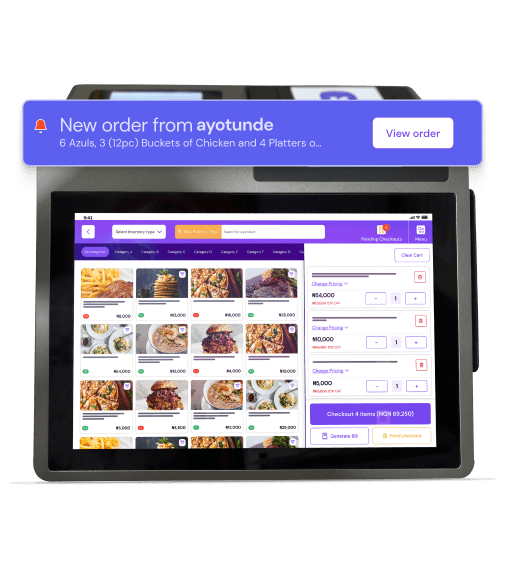
With Lumi Business, restaurants can manage operations end-to-end in one system.
Key capabilities include:
- Table & floor management
- Kitchen Display System (KDS)
- Digital menu management
- Online ordering & reservations
- Recipe management with automatic ingredient deduction
- Inventory tracking with low stock alerts
- Expense management & accounting
- Staff roles & access control
- Offline mode
- Integration with delivery platforms like Chowdeck and Glovo
- Integration with payment platforms like Kuda, OPay, and Interswitch
- Easy reconciliation to detect theft or discrepancies
- Customer Management
Lumi Business is built to serve multiple industries, but its restaurant features are designed to handle dine-in, takeaway, delivery, and financial reporting in one dashboard.
2. eRestaurant Nigeria
eRestaurant Nigeria focuses primarily on restaurant operations.
It typically offers:
- Billing and POS functionality
- Table management
- Kitchen order printing
- Basic inventory tracking
- Reporting tools
It is suitable for restaurants seeking a restaurant-focused POS environment.
3. FoodRuna
FoodRuna provides restaurant management tools that often include:
- POS and billing
- Menu management
- Online ordering
- Basic operational tracking
It is designed to help restaurants digitize ordering and manage customer flow.
4. iClass Restaurant POS
iClass Restaurant POS offers:
- POS billing
- Table service tools
- Kitchen order management
- Reporting
It is typically used by restaurants looking for structured dine-in management systems.
5. Orda Africa
Orda Africa provides:
- Restaurant POS
- Online storefront
- Digital ordering
- Payment integration
It focuses on enabling African food businesses to digitize operations.
6. Mira
Mira offers restaurant technology solutions including:
- POS functionality
- Order tracking
- Operational reporting
It is positioned as a restaurant management software solution.
How to Choose the Right POS Software for Your Restaurant
When selecting a restaurant POS system in Nigeria, ensure it includes the following essential features:
1. Table and Floor Management
A good restaurant POS must allow you to:
- Manage table assignments
- Monitor occupied vs free tables
This reduces billing errors and improves service speed.
2. Kitchen Display System (KDS)
A Kitchen Order Display System (KDS) eliminates paper tickets and miscommunication between waitstaff and kitchen teams.
With a proper kitchen display system, you can:
- Send orders directly from POS to kitchen
- Track preparation time
- Reduce food errors
- Improve coordination during peak hours
3. Digital Menu & Menu Management
Your POS should allow you to:
- Update prices instantly
- Hide unavailable items
- Create categories (drinks, starters, mains, desserts)
- Manage dine-in, takeaway, and delivery pricing separately
This is especially important in Nigeria where ingredient prices fluctuate frequently.
4. Online Ordering & Delivery Management
Modern restaurants need digital ordering capabilities.
Your POS should support:
- Online storefronts
- QR code table ordering
- Integration with delivery platforms like Chowdeck and Glovo
- Delivery fee configuration by zone
- Rider tracking
This ensures all orders — dine-in, pickup, and delivery — are managed from one dashboard.
5. Inventory Tracking & Low Stock Alerts
Food waste and stock pilferage are major problems in Nigerian restaurants. A powerful restaurant POS should include:
- Real-time inventory tracking
- Low stock alerts
- Damaged or spoilt ingredient tracking
- Batch and expiry tracking
- Automatic stock deduction when sales are made
This helps reduce theft and unnecessary losses.
6. Recipe Management
Recipe management connects your inventory to your menu. For example:
If one plate of Jollof Rice uses:
- 200g rice
- 50g pepper
- 100g chicken
The system should automatically deduct those quantities when the meal is sold.
This gives you:
- Accurate food cost tracking
- True profit margin visibility
- Ingredient-level waste control
7. Staff Roles & Access Control
The best POS software for restaurants in Nigeria must allow:
- Role-based access control
- Restricted permissions
- Audit trails
- Employee sales tracking
This improves accountability and reduces internal theft.
8. Offline Mode
Internet downtime is still common in many parts of Nigeria.
Your POS must work offline and automatically sync when the connection is restored.
Without offline functionality, your restaurant risks operational shutdown during network issues.
9. Payment Integration
Your POS should integrate with Nigerian payment platforms such as:
- Kuda
- OPay
- Interswitch
This allows:
- Easy card payments
- Bank transfers
- POS terminal sync
- Seamless reconciliation
10. Accounting, Expense Management & Reconciliation
Restaurant profitability depends on financial visibility.
Your POS should provide:
- Expense tracking
- Daily sales reports
- Profit and loss insights
- Easy reconciliation
- VAT tracking (if applicable)
This helps restaurant owners detect discrepancies, employee theft, and margin leaks early.
Why an All-in-One POS Software For Your Restaurant Is Better
Some restaurants use:
- One system for billing
- Another for inventory
- A third for accounting
- Separate tools for delivery
This leads to:
- Data inconsistencies
- Manual reconciliation stress
- Increased subscription costs
- Operational inefficiency
A unified restaurant POS software eliminates these challenges.
Comparison Table: Best POS Software for Restaurants in Nigeria
| Feature / Platform | Lumi Business | eRestaurant Nigeria | FoodRuna | iClass Restaurant POS | Orda Africa |
|---|---|---|---|---|---|
| Table & Floor Management | ✅ | ✅ | ❌ | ✅ | ❌ |
| Kitchen Display System (KDS) | ✅ | ❌ (Kitchen printing only) | ❌ | ❌ | ❌ |
| Digital Menu Management | ✅ | ❌ | ✅ | ❌ | ✅ |
| Online Ordering / Delivery Integration | ✅ | ❌ | ✅ | ❌ | ✅ |
| Inventory Tracking & Low Stock Alerts | ✅ | Basic | Basic | Basic | ❌ |
| Recipe & Cost Management | ✅ | ❌ | ❌ | ❌ | ❌ |
| Staff Roles & Permissions | ✅ | Basic | Basic | Basic | ❌ |
| Offline Mode (Works Without Internet) | ✅ | ❌ | ❌ | ❌ | ❌ |
| Payment Integrations (Kuda, OPay, Interswitch) | ✅ | Basic | Basic | Basic | Basic |
| Accounting & Expense Tracking | ✅ | ❌ | ❌ | ❌ | ❌ |
| Automated Reconciliation | ✅ | ❌ | ❌ | ❌ | ❌ |
| Delivery Partner Integrations (e.g., Chowdeck, Glovo) | ✅ | ❌ | ❌ | ❌ | ✅ |
Conclusion
Technology adoption in Nigeria’s food industry is accelerating. Quick Service Restaurants and fine dining establishments alike are investing in smarter tools.
The best POS software for restaurants in Nigeria is not just a billing system — it is a complete restaurant management solution that connects:
- Tables
- Kitchen
- Inventory
- Staff
- Delivery
- Expenses
- Customers
- Accounting
- Payments
If your current system cannot manage your restaurant end-to-end, it may be time to upgrade.
Because in today’s competitive food market, operational efficiency is not optional — it is a survival strategy.
Frequently Asked Questions (FAQ)
1. What is the best POS software for restaurants in Nigeria?
The best POS software for restaurants in Nigeria is one that allows restaurant owners to manage billing, tables, kitchen orders, inventory, payments, delivery, and accounting in one system. A complete restaurant POS should reduce manual reconciliation, prevent stock losses, and improve operational efficiency.
2. How much does restaurant POS software cost in Nigeria?
The cost of restaurant POS software in Nigeria varies depending on features and deployment model. Basic POS systems may start at lower subscription tiers, while advanced all-in-one restaurant management platforms with inventory, kitchen display, and accounting features like Lumi Business cost 32,250 Naira/ Month. It is important to compare pricing against the features offered.
3. Does restaurant POS software work offline in Nigeria?
Not all systems support offline mode. The best POS software for restaurants in Nigeria should work even without internet access and automatically sync data when the connection is restored. This is especially important in areas with unstable network connectivity.
4. Can restaurant POS software track inventory automatically?
Yes. Advanced restaurant POS software like Lumi Business can automatically deduct ingredients from inventory when a meal is sold. This is usually connected through recipe management, ensuring accurate stock levels and reducing food waste or theft.
5. Is kitchen display system (KDS) necessary for restaurants?
A Kitchen Display System (KDS) is highly recommended for restaurants with high order volumes. It reduces paper tickets, improves communication between waitstaff and kitchen teams, and helps track preparation time for better service delivery.
6. Can a POS system integrate with delivery platforms in Nigeria?
Yes. Modern restaurant POS systems like Lumi Business can integrate with delivery platforms such as Chowdeck and Glovo. This ensures that dine-in, takeaway, and delivery orders are managed from a single dashboard without duplication.
7. What features should I look for in the best POS software for restaurants in Nigeria?
When choosing the best POS software for restaurants in Nigeria, look for:
- Table and floor management
- Kitchen display system
- Inventory tracking with low stock alerts
- Recipe management
- Online ordering
- Delivery integration
- Payment integration
- Customer Management
- Expense Management
- Staff roles and permissions
- Accounting and reconciliation tools
- Offline functionality
8. Why do some restaurants use multiple systems instead of one POS?
Some restaurant owners believe they need separate tools for billing, inventory, and accounting. However, using multiple systems can lead to data inconsistencies and reconciliation stress. An all-in-one POS system eliminates these issues by centralizing operations.