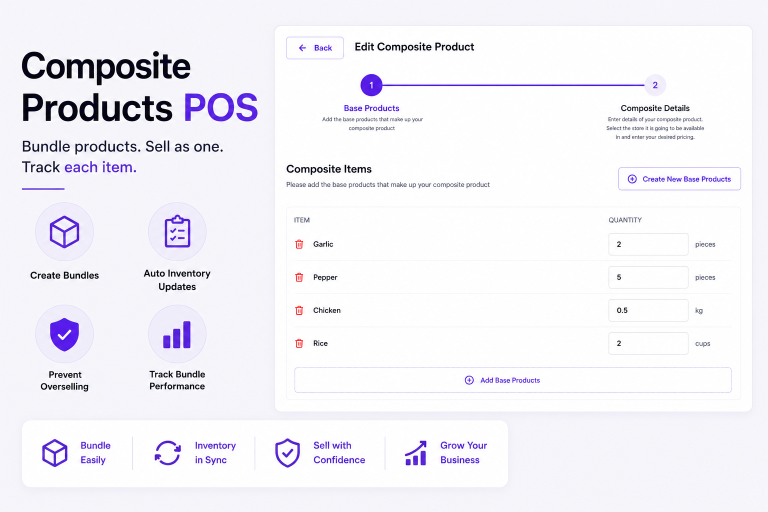
You’ve decided to sell bundled products in your business and you are searching for Composite Products POS.
Maybe it’s a breakfast combo in your supermarket, a baby care kit in your pharmacy, or a meal deal in your restaurant.
The next question is: Can your POS system handle it?
Many retailers discover too late that their POS software wasn’t designed to manage composite products effectively. What starts as a convenient bundle quickly turns into inventory discrepancies, pricing confusion, and manual workarounds.
If you’re evaluating a composite products POS, here are the features that matter most.
1. Does It Track Component Inventory Automatically?
The biggest mistake retailers make is assuming every POS can handle bundled inventory.
Some systems simply record the sale of the bundle without updating the stock levels of the products inside it.
This creates inaccurate inventory records and makes stock reconciliation difficult.
A good composite products POS should automatically update the inventory of each component product whenever a bundle is sold.
Before choosing a system, ask:
“If I sell one bundle today, will the stock levels of the products inside that bundle update automatically?”
If the answer is no, you’ll likely end up making manual adjustments.
2. Can It Prevent Overselling?
Imagine selling a skincare set only to realise that one of the products in the bundle ran out of stock hours ago.
Without safeguards, staff may continue selling products that cannot be fulfilled.
A reliable composite products POS should automatically block the sale of a bundled product if one of its component items is unavailable.
This protects both your customers and your inventory accuracy.
3. Does It Help You Price Bundles Profitably?
Pricing bundled products shouldn’t involve opening a calculator every time you create a new offer.
The right POS should make it easy to understand:
- The combined cost of the products,
- Your expected profit margin,
- The impact of promotional discounts.
This allows you to price confidently without sacrificing profitability.
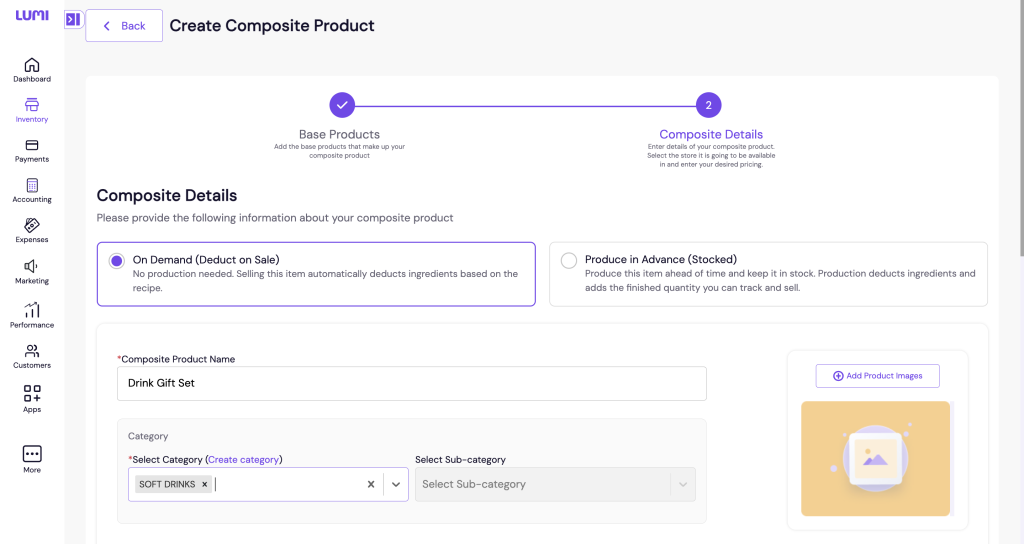
4. Is It Easy to Create New Bundles?
Retail trends change quickly.
You may want to launch:
- A Back-to-School Pack in September,
- A Christmas Cooking Bundle in December,
- A Valentine’s Gift Set in February.
If creating these bundles requires complicated configurations or technical support, your team may avoid using the feature altogether.
The best systems allow staff to build and activate bundles quickly.
5. Can It Adapt to Different Industries?
Composite products aren’t limited to supermarkets.
A flexible POS should support businesses such as:
Pharmacies
Examples include:
- Baby care kits,
- Wellness packs,
- First aid bundles.
Restaurants
Examples include:
- Combo meals,
- Family meals,
- Lunch specials.
- Recipe Management
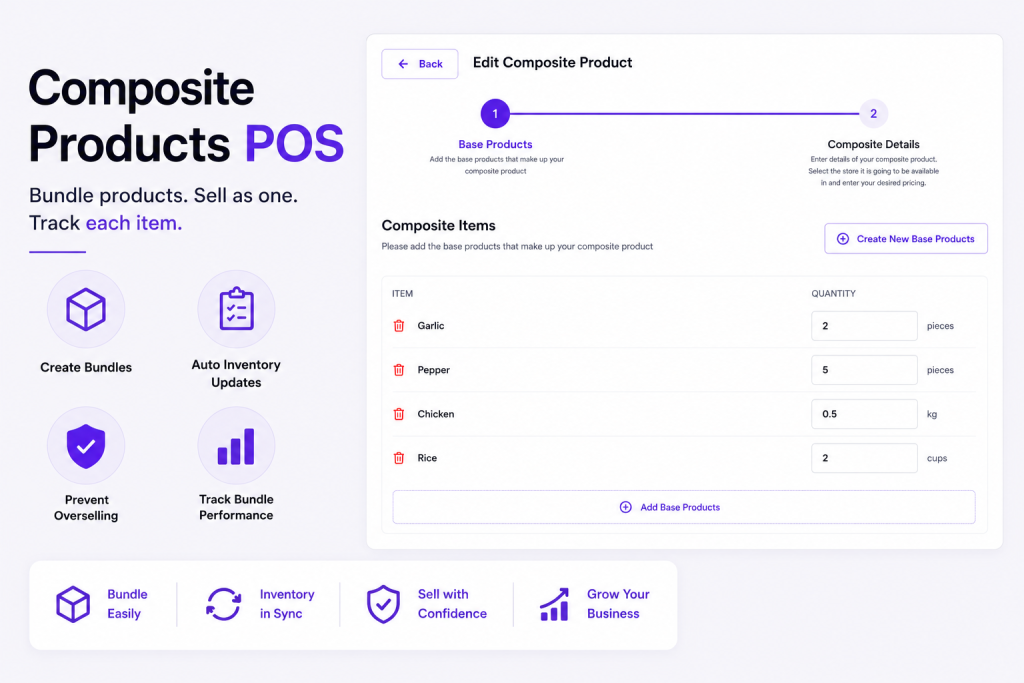
The more adaptable the system, the easier it becomes to grow your bundled offerings.
6. Does It Provide Insights Beyond Sales?
Selling bundles is one thing.
Knowing whether they’re actually working is another.
Your POS should help answer questions like:
- Which bundles perform best?
- Which bundles rarely sell?
- Which promotions should be repeated?
- Which combinations should be retired?
Without this visibility, you’re making decisions based on assumptions rather than data.
7. Will It Save Time for Your Team?
Technology should simplify operations.
If staff still need spreadsheets, calculators, and manual stock corrections after every bundle sale, the POS isn’t solving the problem.
A composite products POS should reduce administrative work so employees can focus on serving customers.
Why This Matters More Than Ever
Consumers increasingly value convenience.
Retailers are responding by packaging products into ready-made solutions that save customers time and simplify purchasing decisions.
However, as bundles become more common, businesses need systems capable of managing them effectively.
Choosing the wrong POS can create operational headaches.
Choosing the right one can improve efficiency, reduce errors, and support growth.
How Lumi Business Supports Composite Products
Lumi Business was designed to help retailers manage composite products without the usual complexity.
Businesses can:
- Create bundled products easily,
- Automatically calculate the total cost price of component products,
- Prevent the sale of bundles when an item is out of stock,
- Maintain accurate inventory records,
- Monitor bundle performance,
- Introduce new bundles without disrupting operations.
Whether you’re running a supermarket, pharmacy, restaurant, or beauty store, Lumi Business provides the tools needed to manage bundled products with confidence.
Conclusion
Not every POS system is built for composite products.
Before choosing one, look beyond basic sales functionality and consider how the system handles inventory accuracy, pricing, reporting, and ease of use.
The right composite products POS doesn’t just process transactions—it helps retailers deliver convenience to customers while maintaining control behind the scenes.
As bundled products become a bigger part of modern retail, choosing a POS that supports them effectively is no longer a nice-to-have. It’s a competitive advantage.