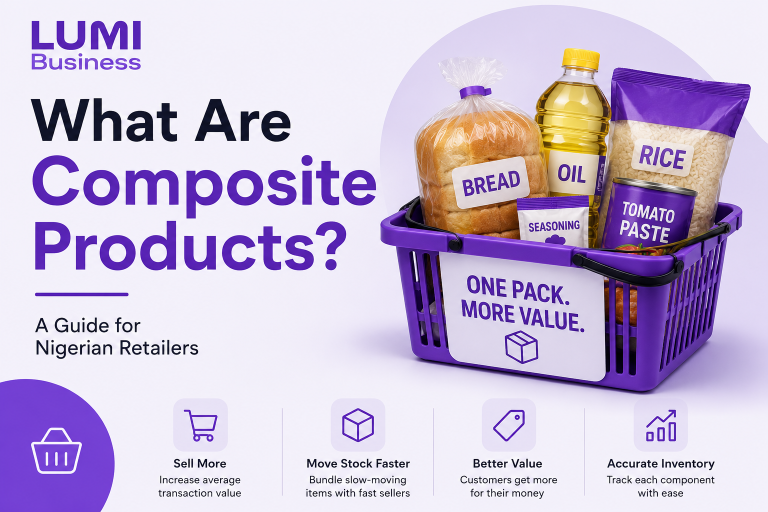
If you’ve ever sold a meal combo, a school starter pack, or a family grocery package, you’ve already encountered composite products.
Yet, many Nigerian retailers don’t realise there’s a name for this strategy—or that modern POS systems can manage it automatically.
As businesses look for smarter ways to simplify operations and improve the customer experience, understanding composite products has become increasingly important.
In this guide, we’ll explain what composite products are, how they work, how they differ from other product types, and why they matter in today’s retail environment.
What Are Composite Products?
A composite product is a product made up of two or more individual items that are grouped together and sold as a single product.
Although customers see one product at checkout, the composite product consists of multiple underlying items.
For example, a supermarket may sell a “Breakfast Essentials Pack” containing:
- Bread
- Butter
- Tea bags
A pharmacy may offer a “Baby Care Starter Kit” containing:
- Baby lotion
- Baby powder
- Baby wipes
A customer purchases one product, but several products are involved behind the scenes.
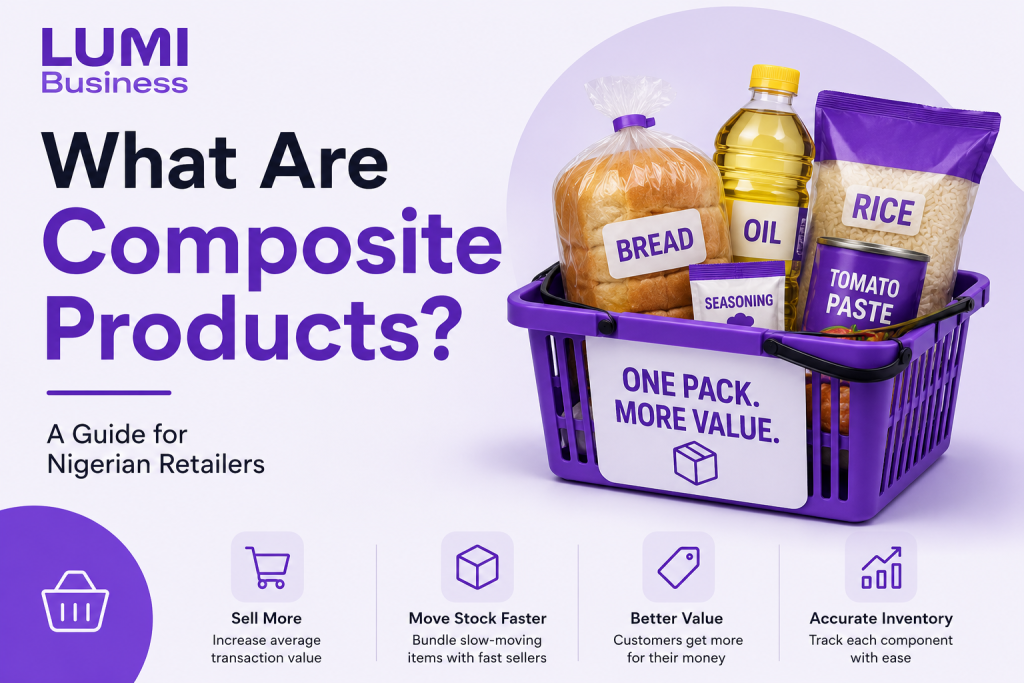
Why Are They Called Composite Products?
The word “composite” simply means “made up of different parts.”
In retail, composite products combine separate inventory items into one sellable offering.
Unlike manufacturing, where products are physically assembled into a new item, retail composite products often remain separate products that are linked together for sale.
This distinction is important because inventory must still be tracked at the individual product level.
How Do Composite Products Work?
Here’s what happens when a customer buys a composite product:
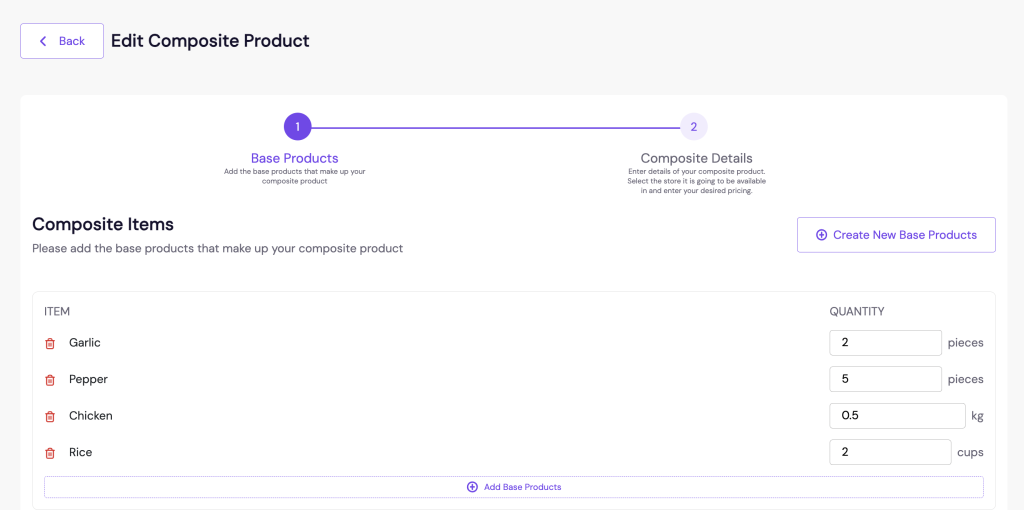
Step 1: The Retailer Creates the Composite Product
The business selects the products that make up the bundle.
Example:
“Sunday Cooking Pack”
- Rice
- Vegetable oil
- Seasoning cubes
- Tomato paste
Step 2: A Selling Price Is Assigned
The retailer decides whether to:
- Price the bundle the same as the individual items combined,
- Offer a discount, or
- Charge a premium for convenience.
On Lumi Business, the cost prices of the individual products in a composite product are automatically summed up, making it easier for business owners to determine the appropriate selling price.
Step 3: The Customer Makes a Purchase
At checkout, the composite product appears as one item.
The cashier doesn’t need to add each product separately on the POS software.
Step 4: Inventory Is Updated
Once the sale is completed, stock is deducted from each individual item included in the bundle.
For example:
If one Sunday Cooking Pack is sold:
- Rice decreases by one unit,
- Vegetable oil decreases by one unit,
- Seasoning decreases by one unit,
- Tomato paste decreases by one unit.
This ensures inventory records remain accurate.
Composite Products vs Product Bundles
The terms are often used interchangeably, but there can be subtle differences.
Product Bundles
Product bundles focus on marketing.
The goal is usually to encourage larger purchases through convenience or promotional offers.
Example:
“Buy these items together and save 5%.”
Composite Products
Composite products focus on operations and inventory management.
The emphasis is on treating multiple items as one sellable product while maintaining visibility into the individual components.
In practice, many POS systems—including Lumi Business—use composite products to power product bundles.
Composite Products vs Product Variants
Retailers often confuse these concepts.
Product Variants
Variants are different versions of the same product.
Examples:
- Small, Medium, and Large T-shirts
- Red and Blue phone cases
- 500ml and 1-litre beverages
Composite Products
Bundled products combine different products together.
Examples:
- T-shirt + Cap + Socks
- Phone + Charger + Earphones
A variant is a choice.
A bundled product is a combination.
Which Businesses Use Composite Products?
Bundled products can be useful across multiple industries.
Supermarkets
Examples include:
- Breakfast packs
- Family grocery bundles
- Holiday cooking packages
Pharmacies
Examples include:
- First aid kits
- Baby care bundles
- Wellness packs
Restaurants
Examples include:
- Meal combos
- Family meal deals
- Lunch specials
Beauty Stores
Examples include:
- Hair care sets
- Skincare sets
- Makeup kits
Bookstores
Examples include:
- Back-to-school packages
- Exam preparation kits
- Stationery bundles
When Should You Use Bundled Products?
Bundled products are most effective when:
- Customers frequently buy certain products together.
- You want to simplify purchasing decisions.
- Convenience is important to customers.
- You want to promote themed packages.
- You need better visibility into grouped product sales.
When Should You Avoid Composite Products?
Bundled products may not be suitable when:
- The products have no natural relationship.
- Customers prefer maximum flexibility.
- Inventory availability is unpredictable.
- The bundle creates unnecessary complexity.
For example, combining toothpaste and soft drinks into one package is unlikely to make sense to customers.
Common Misconceptions About Composite Products
“Bundled products are only for supermarkets.”
False.
Businesses of all sizes and industries can use them.
“You must offer discounts.”
Not always.
Many customers value convenience enough to purchase bundles without a discount.
“They are difficult to manage.”
Not with the right technology.
Modern POS systems like Lumi Business automate inventory deductions and reporting.
“Only large businesses can benefit.”
Even neighbourhood stores can use composite products effectively.
Why Inventory Management Matters
One of the biggest challenges with composite products is maintaining accurate stock records.
Imagine selling a skincare bundle without realising one of the products is out of stock.
Without proper tracking, businesses risk:
- Overselling products,
- Stock inaccuracies,
- Poor customer experiences,
- Revenue leakage.
This is why retailers increasingly rely on POS systems like Lumi Business that support composite products. With Lumi Business, businesses cannot sell a bundle if one of its component products is out of stock.
How Lumi Business Supports Composite Products
Lumi Business enables retailers to manage composite products with ease.
Business owners can:
- Create bundled products directly within the system,
- Automatically deduct inventory from each component item,
- Monitor sales performance,
- Manage bundle pricing efficiently,
- Prevent stock inconsistencies,
- Gain visibility into which combinations perform best.
Instead of manually updating spreadsheets after every sale, businesses can automate the process and focus on serving customers.
Frequently Asked Questions
Are composite products the same as kits?
In many cases, yes. Retailers may refer to them as kits, bundles, combos, or packages.
Can I sell composite products without discounts?
Absolutely. Convenience alone can create value for customers.
Can small retailers use composite products?
Yes. Composite products are useful for both small shops and large retail chains.
Do composite products affect inventory?
Yes. Every item within the composite product should be deducted from inventory when a sale occurs.
Conclusion
Composite products are not just a sales tactic—they are a smarter way to organise, sell, and manage products that customers naturally purchase together.
Understanding how they work helps retailers improve operational efficiency, simplify the shopping experience, and maintain accurate inventory records.
As Nigerian retailers continue adapting to changing consumer behaviour, composite products provide a practical way to package value and streamline operations.
And with tools like Lumi Business, managing them doesn’t have to be complicated.